On this page
Short answer
Florals and damasks bring softness and a sense of occasion to a room. A damask is a woven pattern, usually tone on tone, made by contrasting a shiny and a matt weave; a floral can be woven as a jacquard or printed. Choose a large scale for big windows and formal rooms, and a small or tonal one for bedrooms and modern spaces. Plan the motif so it sits at the same height across every curtain, and keep the rest of the room calmer.
Damask, brocade and printed florals
| Type | How the pattern is made | Look |
|---|---|---|
| Damask | Woven in, by contrasting a shiny satin weave with a matt one; usually reversible | Tone on tone, elegant, catches the light |
| Brocade | Woven in, with extra yarns floating on the surface | Raised and richly decorative; not reversible |
| Jacquard floral | Woven in, often in several colours | Textured, with real depth |
| Printed floral | Printed onto the surface of the fabric | Any colour and detail; flat and smooth |
Woven patterns are part of the cloth, so they cannot rub or wash off, and the fabric has more body. See What Is Jacquard Fabric? for how jacquards are woven.
Classic or modern?
- Classic: large damasks and full-colour florals on French pleats, with tie-backs, in formal living and dining rooms.
- Modern: tone-on-tone damasks, oversized single-colour flowers, or soft botanical prints on S-fold, with plain walls and simple furniture.
- Japandi and resort: small, loose leaf patterns in muted greens and sands, paired with linen-look plains.
- Hotels and suites: a damask on the main curtain, with plain sheers, gives a sense of occasion that suits guest rooms and lobbies.
Choosing the scale
Large motifs need a large window to show a full repeat; on a small window you may see only part of a flower. Small and tonal patterns read as texture from across the room and suit bedrooms and smaller spaces.
Tip
Look at a large sample hung and gathered, from where you normally sit. A damask that looks bold flat often softens into a gentle shimmer once it is in folds.
Placing the motif
- Same height on every curtain. The main motif should start at the same point on each width and each curtain, so the pattern lines up across the window.
- Match across joins. Joined widths must be matched, which needs extra fabric for the pattern repeat.
- A full motif at the top. On a damask, many curtain makers place a complete motif just below the heading, where the eye lands first.
- Allow for the repeat. A large repeat can add a metre or more across several widths. See How to Measure for Curtains.
Pairing pattern with plain
Let one pattern lead. Pick plain walls, a plain sofa and a sheer in colours taken from the floral or damask, and repeat the pattern once more in a cushion or a bed runner. If you want a second pattern, choose a stripe or small check in a shared colour. See Check, Stripe and Plaid Curtains.
Florals and damasks in the JOTEX range
Floral and damask fabrics
Floral and damask collections, updated from the catalogue. See the jacquard fabric page for every woven pattern.
Browse jacquard fabric →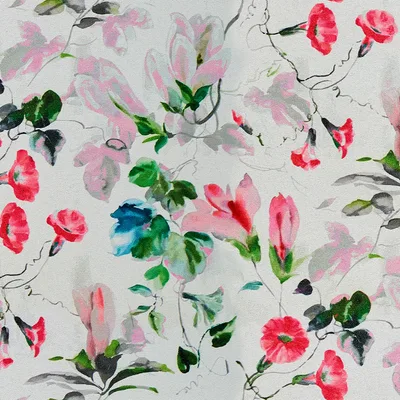
Frequently asked questions
What is damask fabric?
A woven patterned fabric whose design is made by contrasting a shiny satin weave with a matt one. It is usually tone on tone and often reversible, so the pattern shows in reverse on the back.
What is the difference between damask and brocade?
Both are woven patterns. Damask is flat and usually reversible, made by contrasting weaves; brocade has extra yarns floating on the surface, so its pattern is raised and the fabric is not reversible.
Are floral curtains old-fashioned?
Not when the scale and colour are modern. Tonal damasks, oversized single-colour flowers and soft botanical patterns all suit contemporary rooms.
Are woven florals better than printed ones?
Woven florals and damasks have more depth and body, and the pattern cannot wear off. Prints can show finer detail and more colours. Both work; it depends on the look you want.
Do patterned curtains need more fabric?
Usually, because the pattern must be matched across joins and between curtains. The larger the repeat, the more extra fabric is needed.
What goes with damask curtains?
Plain walls and furniture in one of the damask's colours, a plain sheer, and perhaps one cushion or runner in the same damask.
Curtain maker, upholsterer or designer?
Specifications are public on every collection page. JOTEX dealers can log in for live stock and pricing, and our team can send samples or open a dealer account.